
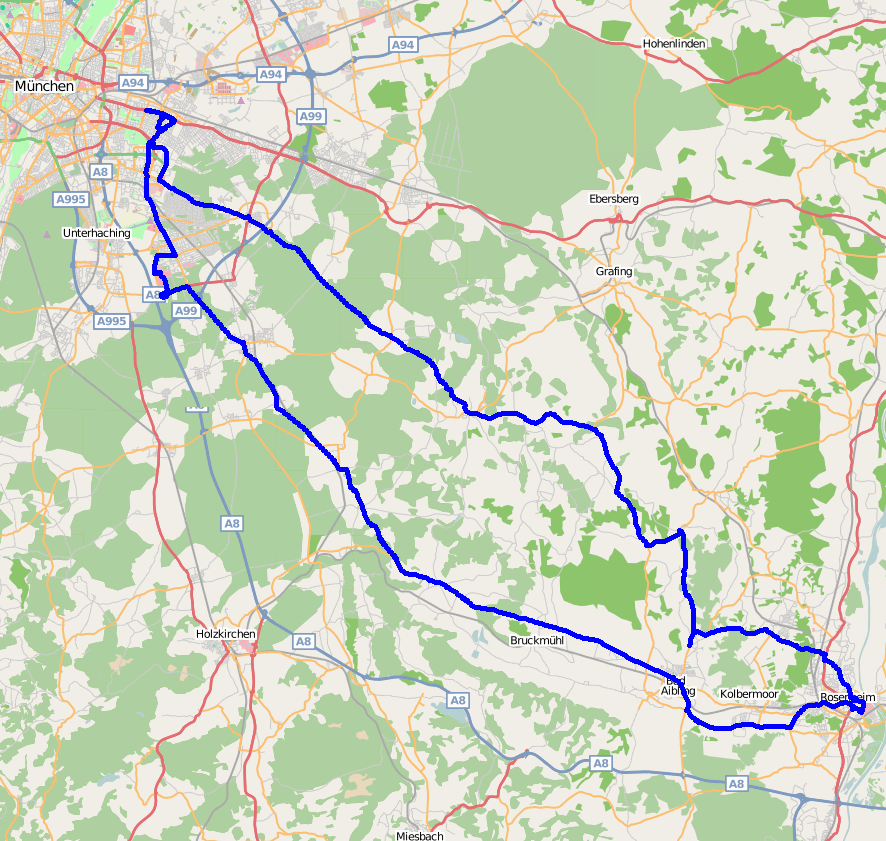
On Saturday, I made a tour to Rosenheim. I wanted to test the charging station mentioned in the LEMnet. After 65 km I did find the Stadtwerke at the correct address and GPS coordinates but I could not find any power outlet on the outside. I sent feedback to Peter Zeller who maintains that list of charging stations.
I decided to return without charging and change this fun tour into a range test for my TWIKE.
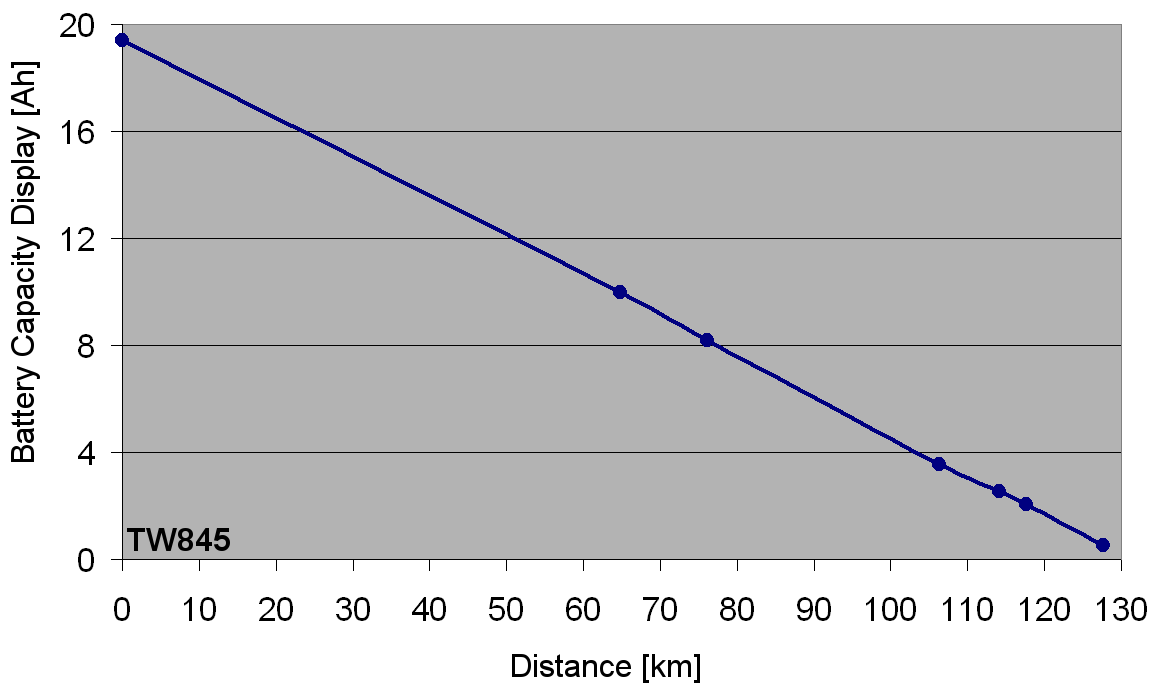
I started with 19,4 Ah on the display and after 127,7 km it still showed 0.54 Ah. The graph on the right side shows that the capacity display is almost linear with the distance.
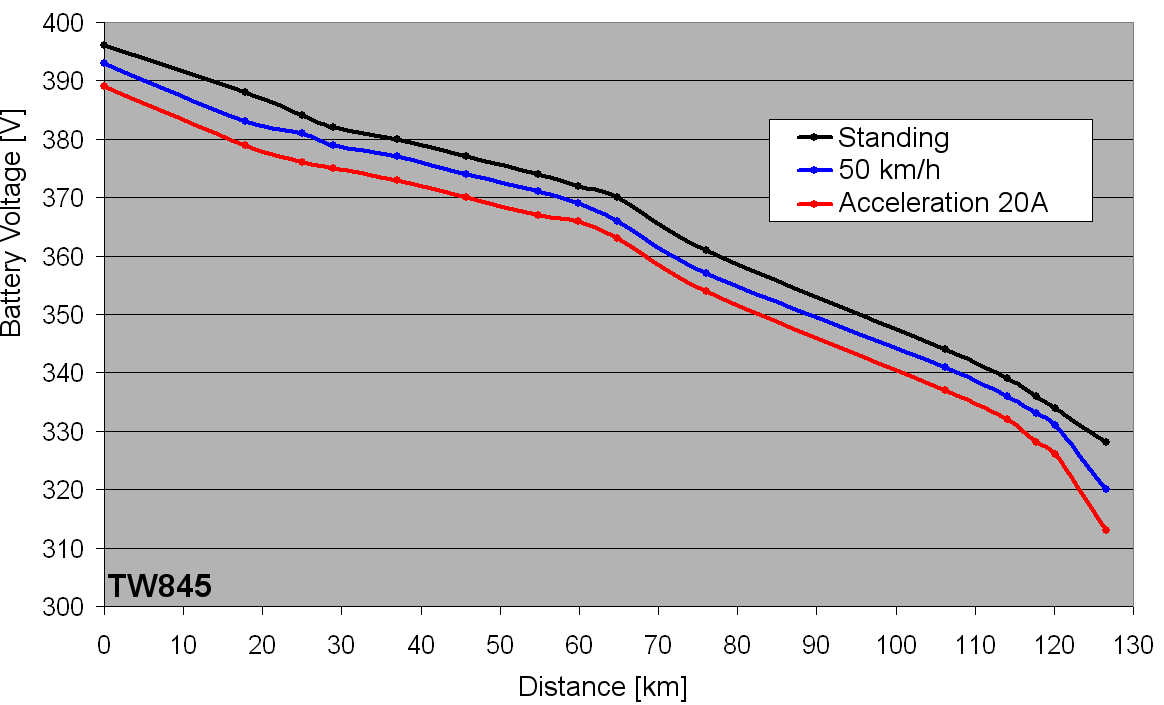 During the tour I monitored the battery voltage and made short stops to note down three voltages:
The graph on the right side shows the voltage at those conditions. One can see that the voltage drop under load is pretty constant until approx. 10 km before the end when the voltage drop at full acceleration increases noticeably. This is a definitive sign for getting close to the end of the capacity. I stopped the tour at 127,7 km and 0,54 Ah. I think I could have done a few more Kilometers without problem.
The voltage over time shows the various phases of my drive. In the parts 0-20km, 55-70 km and starting at 115 km I was driving in urban area with lots of Stop-and-Go.
On the country roads on the first half (Kilometer 20 to 55) the GPS showed an average speed of 58 km/h. That corresponds to approx. 62 km/h on the TWIKE display. On the way back (between Kilometer 70 and 110) I had an average speed of 53 km/h (approx. 56 km/h on the TWIKE display) on the country roads.
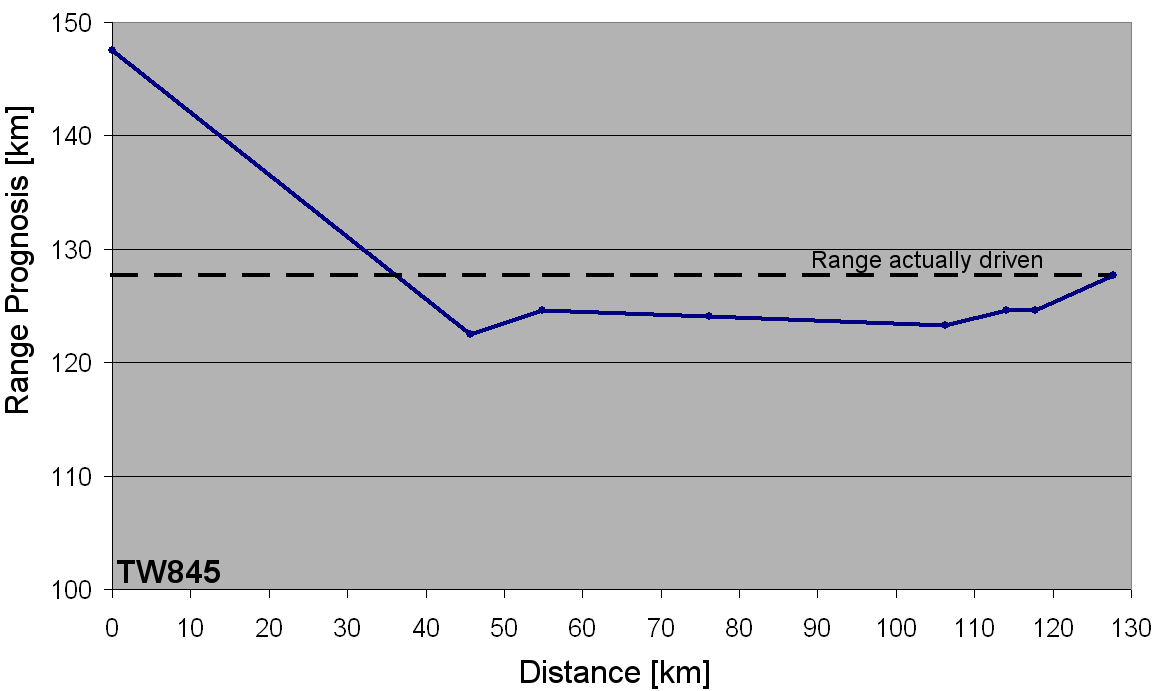
I was curious on how the range prognosis on the trip computer matches the real xxx. The graph on the right side shows the range prognosis over the distance driven. At the beginning, the trip computer showed 147,5 km range after the full charge. According to the manual, the trip computer calculates the first prognosis out of the energy used after the first 5 km of the tour but I did not check if that was the case.
As one can see, the range prognosis did adapt quickly to my driving style. The prognosis is a bit conservative - it typically showed five Kilometers less than I finally did drive. If you use the whole battery capacity down to the absolute limit, I assume that one could drive 10 to 15 km more than the prognosis shows for most of the time. I think this is a good compromise. Additionally, one could change parameter 97 of the trip computer to adjust the final capacity.
In my opinion, the initial prognosis of 150 km with a 20 Ah battery is a bit high.
| Distance driven: | 127,7 | km | ||
| Battery capacity used: | 18,86 | Ah | ||
| Consumption (Battery) | 6,77 | km / Ah | ||
| Consumption (Mains outlet) | 6,0 | kWh / 100km |
After 1432km, the Lion battery makes a powerful impression. Over the whole capacity, the internal resistance seems to be pretty low - one has to remember that even with an acceleration of 20 Amps each cell only gets burdened with 1C! This also gives a solid performance when driving uphill.
The display of the range and battery capacity is very reliable. What one sees on the display can safely be used.
I cannot say if and with which driving style one can reach a range of 200km.